 ES
ES
 IT
IT
 PT
PT
 DE
DE
 NL
NL


Blask Index, Blask’s real-time measure of search-driven demand for iGaming brands, tells a more uneven story: demand rose by double digits in most tracked countries, but the size of the move, and the day it happened, had almost nothing to do with match importance.
Panama gained the most, Uzbekistan lost the most, Brazil netted out flat
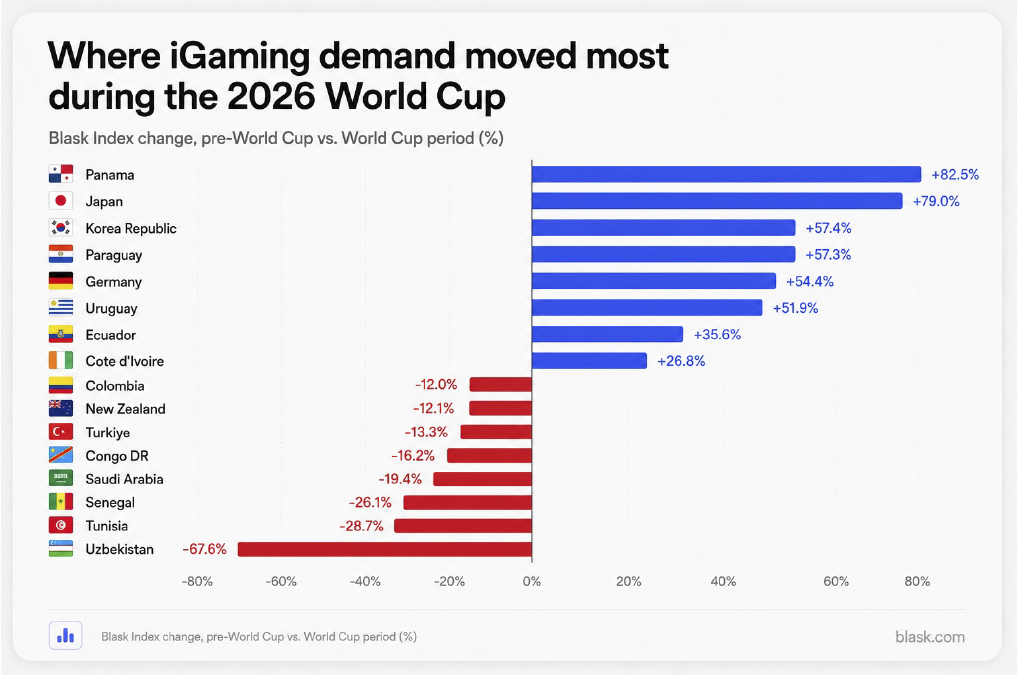
Panama’s demand rose 82.5% without the team even qualifying. Japan, Korea Republic, and Paraguay — all eliminated by the Round of 16 — filled out the rest of the top five gainers alongside Germany. Uzbekistan fell 67.6% in its first-ever World Cup; Tunisia, Senegal, and Saudi Arabia also posted double-digit declines despite reaching the tournament.
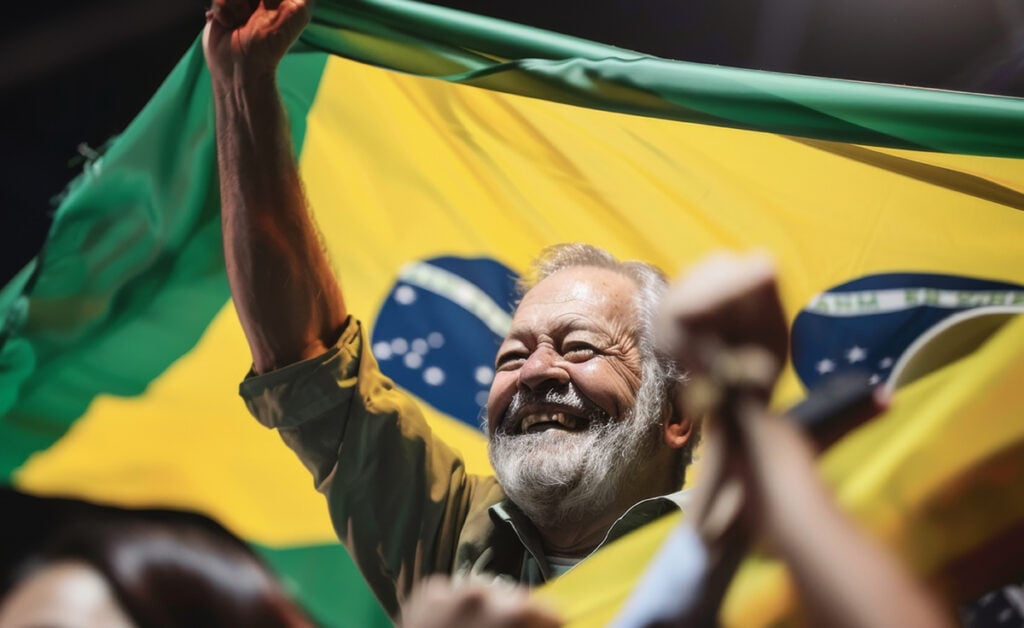
Brazil, the biggest market in the dataset, netted out at −0.5% — a flat number that hides a real swing. Blask’s own tournament coverage shows Brazil running 7.9% above baseline through the team’s run, then reversing hard after its Round of 16 loss to Norway, falling to 27% below baseline by end of July 11. The World Cup moved Brazil’s market up, then down, fast enough to cancel out in one before-and-after number.
Attention peaked early, not at the final
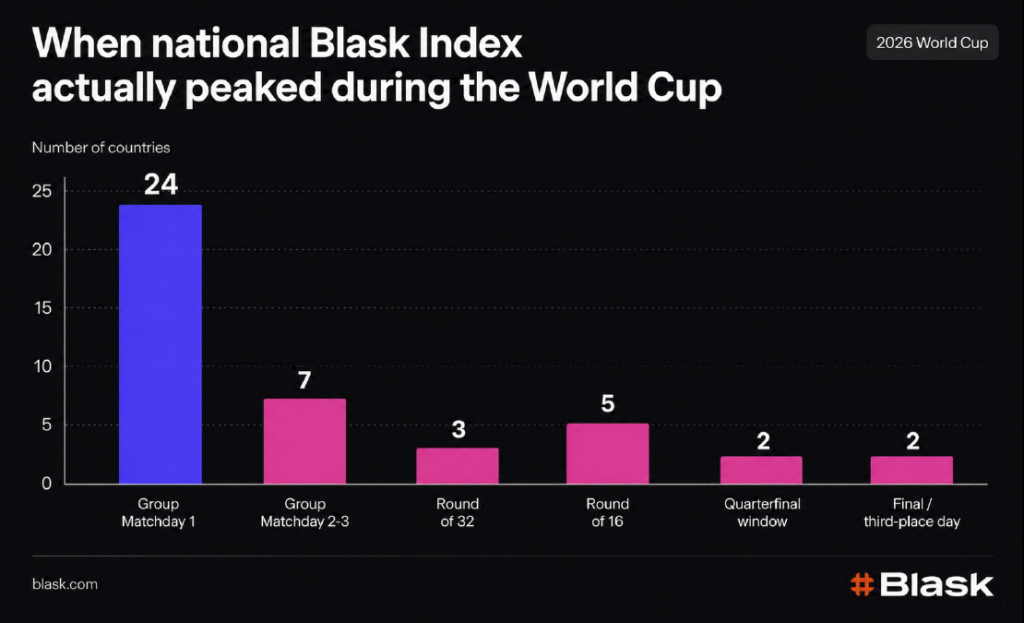
24 of the 43 tracked countries hit their tournament-high Blask Index reading during the opening week (Group Matchday 1, June 11–17) – including Belgium and Switzerland, both of which went on to reach the quarterfinals.
Where a country peaked later, it was almost always tied to its own elimination match: Colombia on July 3 (Round of 32), Canada, Mexico, France, and Paraguay on July 4–5 (Round of 16). Congo DR and Austria are the exceptions – both peaked on the final weekend despite being eliminated long before, more likely a generic late-tournament (or backfill) effect than a specific match.
Argentina is the clearest case. Its tournament-high landed June 20, on a national holiday, not a match. By the final on July 19, its betting-brand demand sat 63% below that high, even as the broader World Cup Index (general tournament interest, not betting-specific) spiked 89% the same day. That’s a search-demand story, not a handle story: sportsbook handle for the final hit record highs at several major operators the same day – bettors who’d already made up their minds didn’t need to search for a brand. Spain shows a milder version: its peak fell the eve of its opener, not the day it won the final.
The World Cup competed with the existing calendar – and sometimes lost
France’s high landed July 4, the same day the Tour de France began in Barcelona; its actual 2026 peak came in May, during Ligue 1’s close. The UK never produced a World Cup peak at all – its three biggest single-day spikes were all horse racing, Grand National Day and Cheltenham Festival, even though football has out-earned racing in aggregate every year since 2019 – this is a single-day comparison, not a season-long one.
The US and Canada told the same story: US highs landed on days already stacked with the Daytona 500 and NBA All-Star Game, and with March Madness, the WBC, and a UFC card; Canada’s WC-period peak sat 22 per cent below its actual 2026 high (set in March), and Mexico’s came in 18.5 per cent below its own March peak.
Football culture, not results, explains where the floor holds
Blask’s Europe and LATAM World Cup reports (2018/2022) show the same mechanism at smaller scale. Germany posted positive demand in every major tournament regardless of result (+14.5%/+9.4%/+10.3% across WC2018, WC2022, Euro 2024). The Netherlands gained in both cycles and held a floor 12.5 per cent above baseline after 2022 – the clearest retention story in Europe. Italy, with no national team in either tournament, contracted both times. Peru and Chile posted the region’s biggest gains without qualifying at all, though that demand ran through offshore channels since neither had a regulated online market at the time.
Brazil is the standout: average demand grew roughly 26-fold between 2018 and 2022 – entirely before the country’s market was even regulated, which only happened on January 1, 2025. If a World Cup can reset the floor in a grey market, a regulated one after WC2026 is worth watching just as closely.
What this means for operators
The tournament-size story is real at the aggregate level. It says nothing about where or when any single market’s demand actually moves. Opening week draws more attention than the final in most countries. A country’s own elimination match, not the tournament’s biggest games, drives its peak. And in markets with a dense existing sports calendar, the World Cup competes with, and sometimes loses to, events that market already runs every year.