ES
 IT
 PT
 DE
 NL


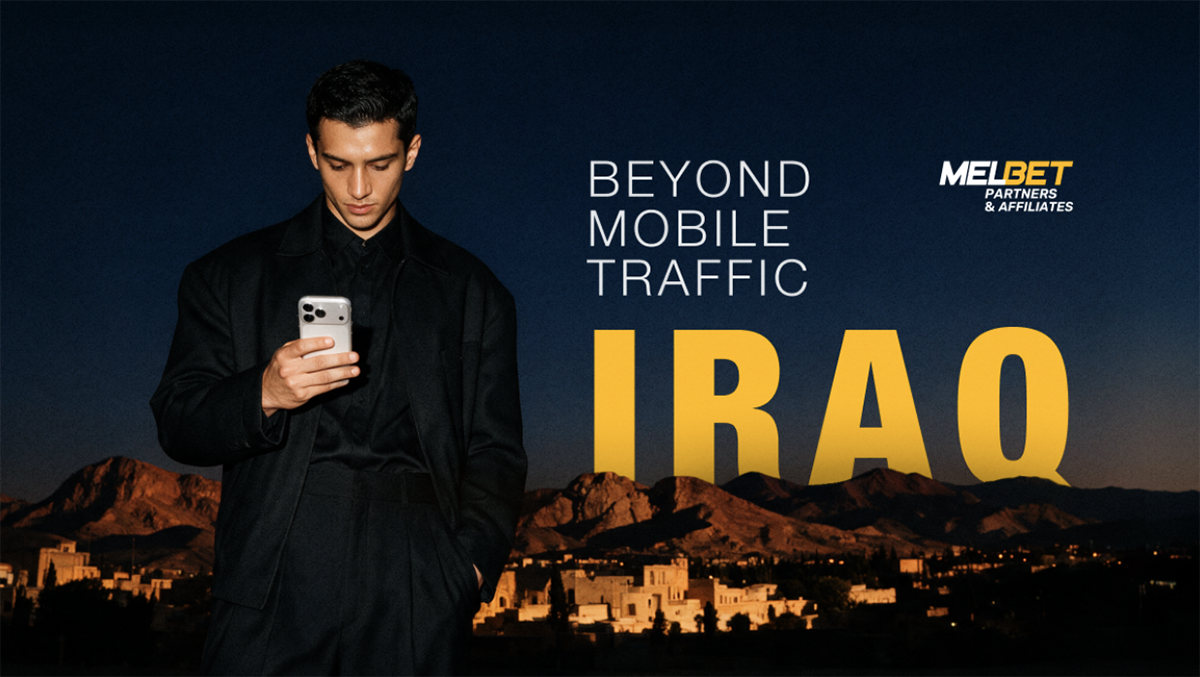
Let’s be honest: when it comes to new markets, Iraq is the last country people think of. When I tell MelBet Partners & Affiliates partners about promising MENA markets and suggest Iraq, the level of surprise goes through the roof. The first question is usually: is affiliate marketing worth it in a country like this?
Most people are used to seeing this country exclusively through news about politics, conflict and economic difficulties. But behind that image it’s easy to miss the other side of Iraq: millions of active internet users, the popularity of social networks and the rapid development of digital services. Today I’ll introduce you to the country a little more closely.
- Population: around 47 million.
- Internet: 39.6 million users, or 83.8% of the population.
- Mobile connections: 50.8 million (108% of the population).
- Social media: 40.1 million user identities.
- Capital: Baghdad, the largest city and the country’s political and economic centre.
- Currency: Iraqi dinar (IQD).
- Official languages: Arabic and Kurdish.
- Mobile devices: according to our statistics, 82% run on Android and the remaining 18% on iOS.
If you set aside the country’s media image and political games, it is no different from other promising markets in the MENA region. Iraq’s key advantage is the popularity of smartphones and how actively they are spreading among residents.
According to DataReportal Digital 2026, mobile connections grew by 2.7 million over the year, and social media user identities by 5.8 million.
Yes, the number of connections can’t be equated with the number of unique users. But these figures clearly show how important the smartphone is for local users. What else characterises the local audience?
This is where it gets more complex. Iraq is not a homogeneous country, and its audience can’t be understood from general statistics alone.
In the north of the country lies Kurdistan, a historical, geographical and ethnocultural region. Its main paradox is that it has no single official state: its territory is divided between four countries, including Iraq.
Kurdistan has its own governing bodies, cultural traditions and economic specifics. You can’t look at Iraq without considering Kurdistan.
Accordingly, Kurdistan’s audience differs from users in other parts of Iraq in income level, attitude to new digital products and consumer habits. The portrait of the average user in the region looks like this:
- Age: 20–35.
- Income: $500–600 a month. In more affluent segments, especially in oil-producing regions, $1,500–2,000 and above.
- Language: Arabic; in Kurdistan, Kurdish (including Sorani and Kurmanji).
- Social networks: TikTok, Facebook, Telegram and WhatsApp.
- Interests: football, mobile games, short videos, humour and local entertainment content.
- Game preferences: Crash, Crystal, Western Slot, Apple of Fortune, Burning Hot and Aviator. Live casino is less popular.
- Activity time: mostly evening and night.
- Behaviour: actively engages with content, discusses and shares posts. Responds well to familiar everyday situations and local humour.
- Cultural specifics: sensitive to religious and political symbolism and military themes.
Since two languages coexist in the country, this needs to be taken into account. Arabic and Kurdish are both enshrined in Iraq’s Constitution. In Kurdistan, different varieties of Kurdish are widely used, including Sorani and Kurmanji. In other regions Arabic dominates, with its own local dialect features.
This means Arabic alone isn’t enough. You need comprehensive localisation of your creatives and promos to reach every segment of your target audience. And of course, don’t forget local memes, humour, figures of speech and other cultural codes. That’s the only way the audience will trust you. Cultural context is also exactly where you need to be extremely careful.
For example, religious and political symbolism in Iraq requires extreme caution. Even visuals that are perceived as neutral in other markets can trigger a negative reaction here. And this applies not only to politics and religion, but also to individual storylines involving weapons and military themes.
Now let’s look at how Iraqis spend their time online.
People in the country love social networks, short videos (Shorts, Reels), humour and content they can share with friends. Locals actively discuss posts, react to familiar life situations and engage with stories in which they recognise themselves.
- Facebook: reaches around 60% of users.
- Instagram: an audience of around 21.5 million (according to Meta).
- TikTok: 75% of users, with year-on-year audience growth.
- Telegram and WhatsApp: widely used for messaging, sharing posts and communicating in groups and communities.
Besides social networks, Iraqis spend a lot of time on games and other entertainment. Most interestingly, peak activity falls in the evening. Keep this in mind when planning your campaigns.
Now to entertainment itself. As in many other countries, football is number one. It is part of the culture and everyday life. People play football from childhood, and matches are discussed in families, among friends and on social media. Over the past year, the national team has also given fans a historic reason to celebrate.
In March 2026, Iraq beat Bolivia 2–1 in the intercontinental play-off and qualified for the World Cup for the first time in 40 years. It was only the national team’s second World Cup appearance since its debut in 1986.
During Iraq’s national team matches, player activity grew noticeably, not only on social media but also in sports predictions. Sporting events like these show how much shared emotions, national achievements and match discussions matter to local people.
As for gaming habits, our regional teams’ experience shows the following: the country is dominated by simple games with fast mechanics and short rounds.
Crash, Crystal, Western Slot, Apple of Fortune, Burning Hot, Aviator, Ocean Legacy and Chicken Road.
Live casino, on the other hand, hasn’t really taken off. The response to these formats is mediocre, with no significant audience growth. There are markets where live games perform many times better.
No talk about Iraq’s digital audience would be complete without its financial infrastructure.
The situation is this: Iraq is gradually expanding the use of electronic payments, and the changes are visible in official data.
In August 2024, the Central Bank of Iraq reported that transactions through national payment systems exceeded IQD 2 trillion in July, compared with IQD 800 billion in the same month of 2023.
The number of POS terminals has also grown significantly. According to open sources, it rose from 11,000 at the start of 2023 to more than 50,000 in 2024.
And in February 2025, the Central Bank stated that financial inclusion had reached 40%, up from around 20% roughly two years earlier.
The data clearly shows expanding access to financial services for local residents. Not everyone uses them evenly or regularly, but the trend itself is extremely important.
What does this mean for affiliates? You need to approach payments very carefully. It’s not enough to simply add them as an option: check their relevance for the audience and spell out all the terms, including whether there are fees. All information must be accurate and transparent for local users.
To sum up, here are a few tips for working in Iraq:
- Don’t treat the whole country as one GEO. Baghdad, Basra and Iraqi Kurdistan differ in language, economic conditions and consumer habits. Study each audience segment separately first, and only then start working.
- Pay more attention to players’ mobile experience. Check loading speed, how content is displayed and how convenient interfaces are on devices across different price ranges and operating systems.
- Comprehensive localisation only. For Kurdistan, you need to account for the Kurdish language and its regional varieties. User guides, terms and support should be available in several languages.
- Respect cultural specifics. Check local materials for the appropriateness of religious, political and historical references. Don’t transfer images and wording from other MENA countries without consulting local managers.
- Don’t push. Trust in the brand matters a lot here. So work on it and don’t rush players. Once they see they can trust you and that your product is high quality, they’ll move through the funnel without problems.
I hope you now see the difference between the real picture of the country and the one painted by the news and media. Iraq has many young, active and engaged people who love sport and fast games. The country is developing not only financially but also digitally. This is visible not only in our internal statistics, but also in statements from official representatives of the country.
In conclusion: don’t try to understand a market only through statistics and dry figures. Find out how people use technology in everyday life, which services they trust, what language they communicate in and what restrictions exist for your product. The better you understand these details, the more accurately you’ll be able to assess the prospects for developing and scaling your campaigns.